
Conservatory Cleaning in Eaglescliffe.
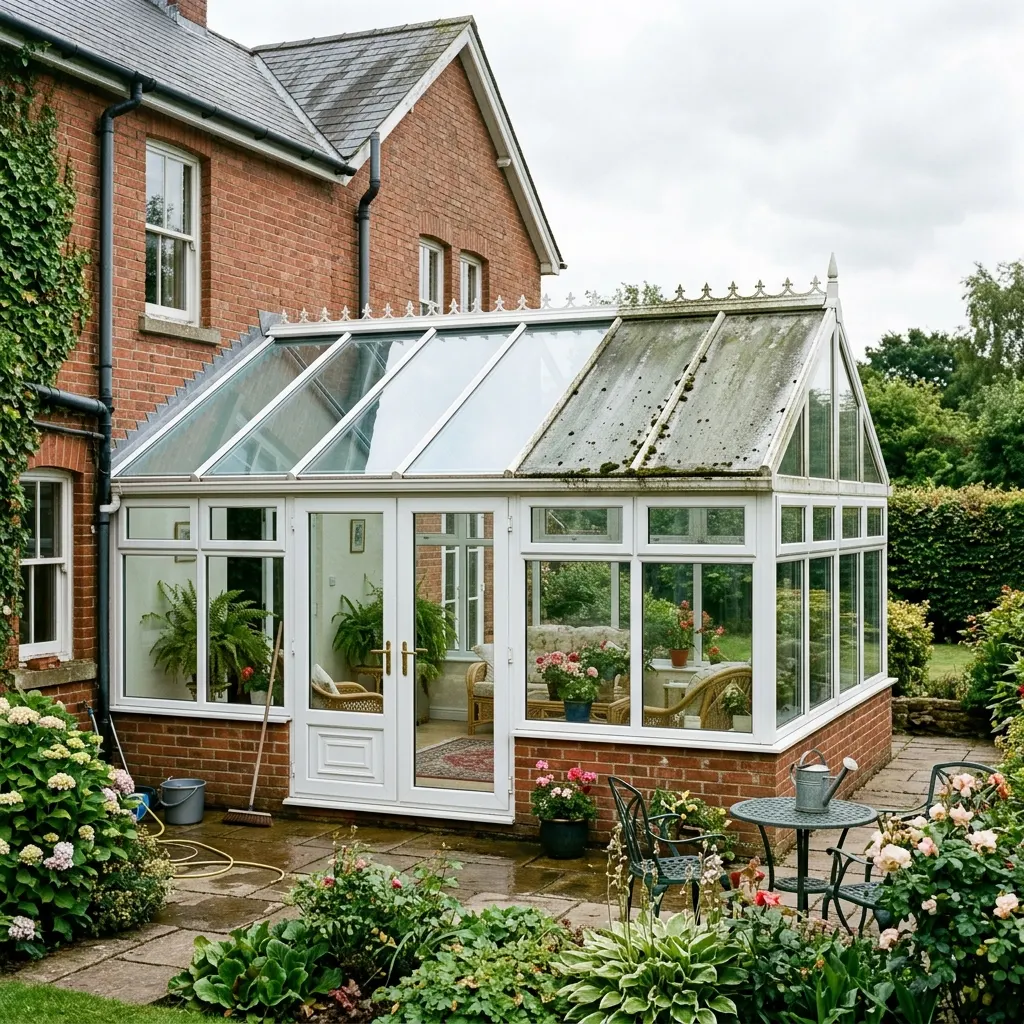
Walk the boundary of almost any substantial garden near Eaglescliffe Village or out toward Cleveland Lodge and the reason conservatory roofs here struggle to stay clean becomes obvious: mature trees crowd close to the house, and what drops from them changes with the season rather than staying constant. April and May bring a fine dusting of pollen worked into every gasket and glazing bar. By June, sap is dripping steadily onto polycarbonate and glass from the canopy overhead. From October, that same canopy sheds leaf litter that packs into box gutters and hidden internal valleys faster than most homeowners realise. Our Conservatory Cleaner Eaglescliffe service is built around that cycle rather than treated as a one-size-fits-all wash - we soften baked-on sap out of the UPVC framework, clear compacted leaf mulch from valleys hidden behind the roofline, and lift pollen residue out of seals and glazing bars, using long-reach carbon fibre poles and heated pure water so nobody has to put a foot, a ladder or a knee on a roof that was never designed to carry that weight.
What Eaglescliffe customers actually say
“Very professional operation. Very happy with the work. I would highly recommend this company.”
“Great service”
“Great communication and fit us in quickly. Thanks”
Canopy-Ready Restoration.
Shielding your Eaglescliffe conservatory from sap, pollen and leaf litter, season by season.
What The Tree Canopy Really
Costs A Conservatory In Eaglescliffe.
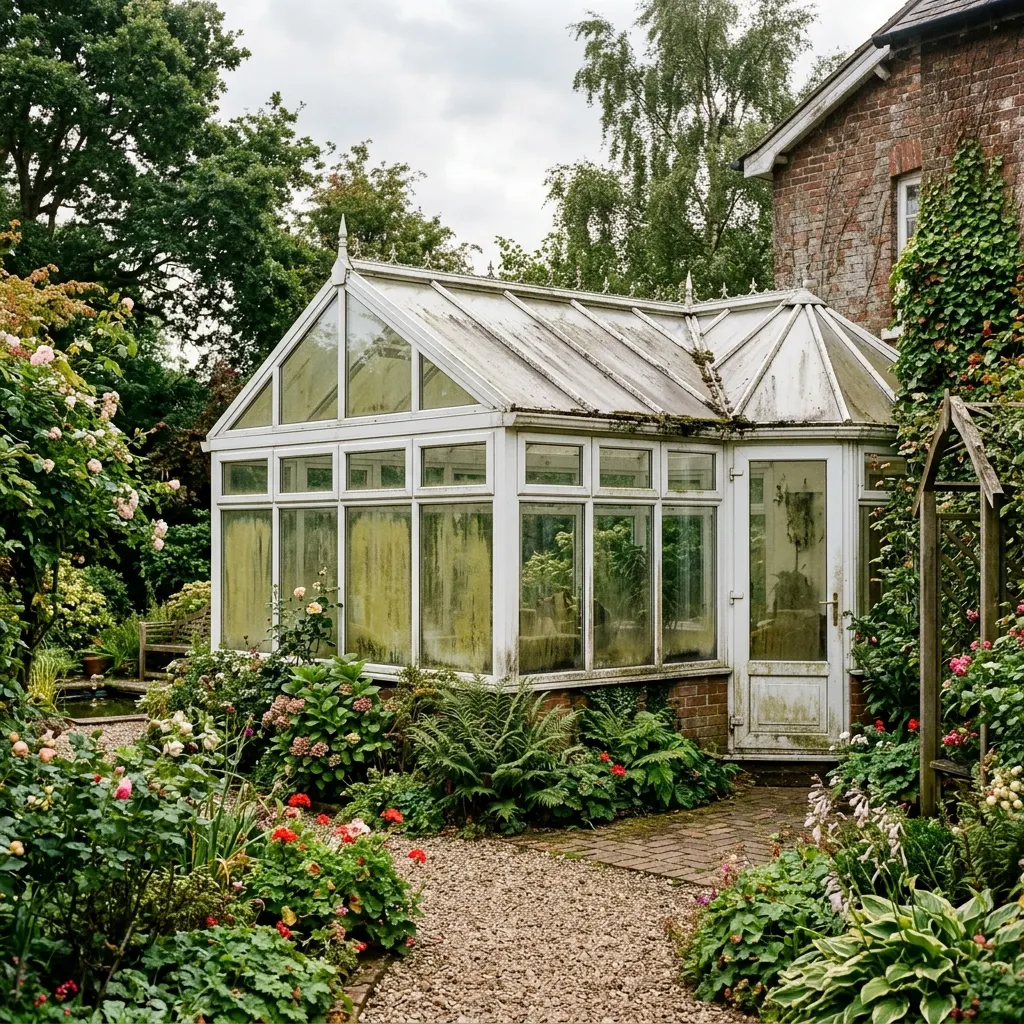
A conservatory is usually one of the largest single sums a homeowner in Eaglescliffe puts into their property outside the house itself, and it is also the part most exposed to whatever the garden throws at it. Around Cleveland Lodge and the riverside plots that back onto the Tees, mature beech and sycamore grow close enough to the house that a conservatory roof spends much of the year in dappled shade rather than full sun. That shade sounds like a mercy in August, but it comes at a price the rest of the year: sap dripping onto polycarbonate and glass as the trees come into leaf, pollen settling into every seal through April and May, and leaf litter working steadily into the valleys and box gutters from October through to the first hard frost. Add the low-level traffic film drifting in off the Yarm Road corridor and a conservatory here can lose its clarity within a single season if nobody intervenes.
At Operation Clean we never treat a conservatory as an oversized window, because that approach misses most of where the damage actually happens. Whether we are working on a Victorian-style build in the older streets of Eaglescliffe Village or a newer addition out toward Urlay Nook, our Conservatory Cleaning Eaglescliffe visits cover the entire structure from ridge to sill. We start at the finials and crestings where wind-blown debris settles first, work heated water into the porous white UPVC to draw out sap and grime that has bonded to the plastic, and finish by clearing the box gutters and internal valleys that carry rainwater away from the house wall. Stop at the glass and you leave the framework to discolour and the drainage to silt up quietly - which is exactly where the expensive problems start.
Our process combines heated, purified water with a professional-grade Traffic Film Remover (TFR), and in Eaglescliffe both halves of that pairing earn their place. The TFR breaks down the oily film that drifts off the Yarm Road corridor and settles on glass and frame alike, while the heat is what actually shifts sap that has already hardened - a cold rinse tends to slide straight over it rather than through it. Warming the water also opens the microscopic pores in the UPVC framework, letting the solution draw sap and airborne grit out of the surface instead of just smearing it sideways across the glass, which is the real difference between a conservatory that looks clean for a week and one that stays that way for months.
Every Conservatory Style, Priced On Its Own Terms
We quote against the shape, complexity and scale of your conservatory rather than a flat rate, because a lean-to on a terrace and a gable-ended structure on a riverside plot are simply different jobs. Select your style when booking so we can allocate the right amount of time and equipment.
Victorian
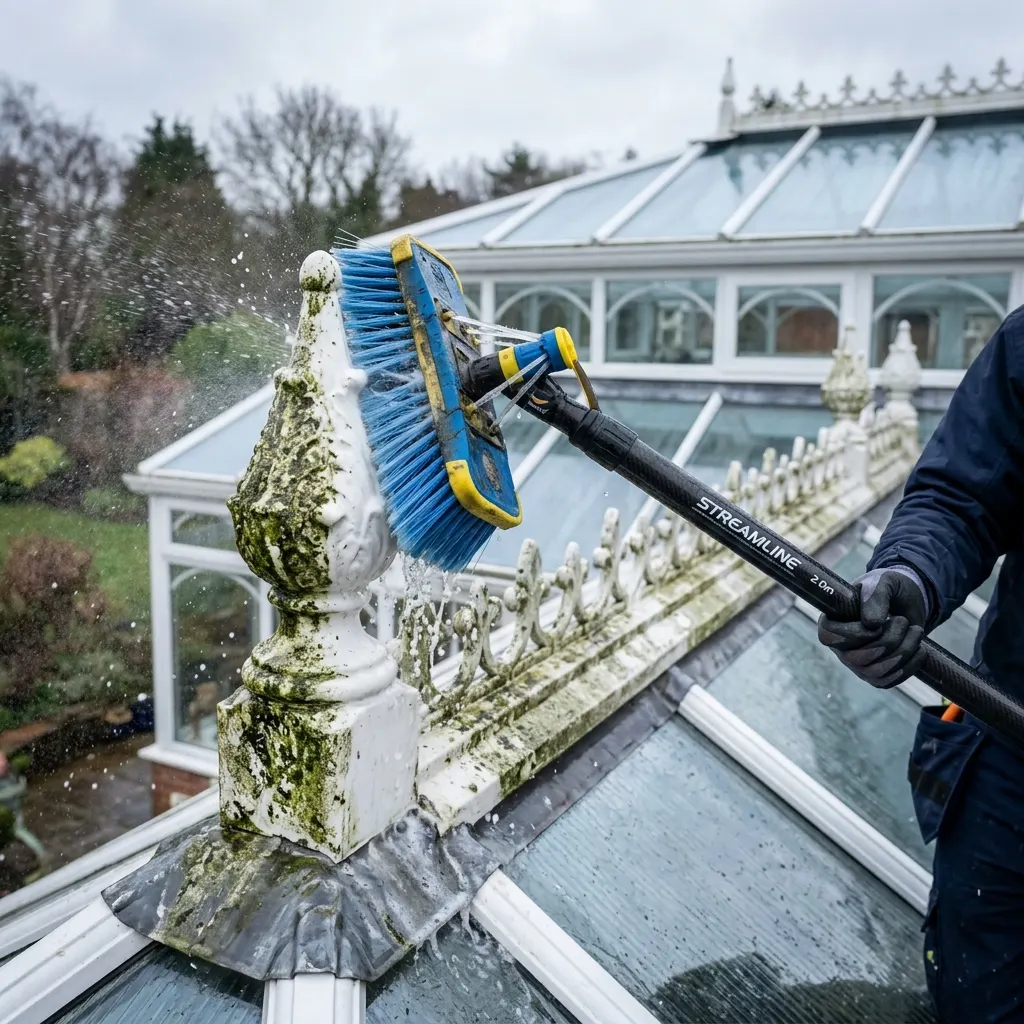
Victorian conservatories are common across the older parts of Eaglescliffe Village, easy to spot from their bay fronts, steep roof pitches and ornate ridge details - the finials and crestings running along the apex. Those details sit directly beneath the tree canopy found through much of the village, so they are the first place falling debris, bird droppings and algae spores land on the whole structure. We work these ridges with precision-angled high-reach poles, agitating the crestings by hand rather than trusting a passing rinse to do the job, so nothing is left up there to wash down and re-stain the glass below during the next downpour.
Technical Standard
Edwardian / Georgian
Edwardian and Georgian conservatories favour a flat-fronted, symmetrical design with a wide, shallow-pitched roof, a style well represented among the larger properties around Cleveland Lodge. Without the ridge crestings of a Victorian build, the main risk here shifts to the internal valleys and box gutters, which carry the full run-off from that wide roof pitch on top of whatever leaf litter has blown in from neighbouring gardens. We concentrate on flushing these drainage points thoroughly, because on this style of roof a blocked valley sends water and debris straight back toward the join with the house rather than clear of it.
Technical Standard
Gable / P-Shape / Lean-To
The larger detached properties toward Low Eaglescliffe and the riverside plots tend to carry the biggest and most complex roofs we see - full gable ends, P-Shape combinations pairing a lean-to with a Victorian or Edwardian end, or long lean-tos running the full width of the house. More roof means more valleys, more high-level glass, and considerably more surface area for sap and leaf litter to settle on. We use rigid carbon fibre poles rated for four-storey reach to cover these spans safely from the ground, which matters on a property large enough that a ladder cannot reach the centre of the roof without being repositioned again and again.
Premium Plus
Why Your Roof Turns Green
Around Eaglescliffe, prevailing winds carry organic spores off the mature tree lines near Urlay Nook and the wooded plots around Cleveland Lodge, along with agricultural dust drifting in from the surrounding countryside. Once those spores land on a conservatory roof that spends much of the day in shade, colonisation begins quickly - and it follows a predictable pattern.
Phase 1: The Colonisation Phase
Long before any green discolouration is visible to the naked eye, a thin biofilm has already formed across the UPVC framework and roof glazing. It behaves like a net, catching soot from passing traffic, airborne dust, and the sticky tree sap that falls heavily from the canopy overhanging much of Eaglescliffe. In the damper, more sheltered gardens closer to the river, this biofilm builds noticeably faster than it would on an open, exposed roof.
Phase 2: The Visible Bloom
Fed by that trapped organic matter, the biofilm develops into Chlorophyta - green algae - and the roof shifts visibly from slightly dull to clearly stained. Green colouring creeps up the glazing bars and spreads across the polycarbonate or glass panels, while moss spores start anchoring into the rubber gaskets and structural seals, drawn to the moisture held within the joints of the frame.
Phase 3: The Structural Breach
Beyond this point the problem stops being purely cosmetic. If a conservatory in Eaglescliffe goes without a proper clean for more than 12 to 18 months, established algae starts breaking down the surface minerals of the plastics and rubbers it is growing on. Polycarbonate panels pit until they look permanently cloudy, and rubber gaskets dry out until they shrink and lift away from the glass - at which point leaks, winter draughts and blown double-glazing units become a matter of when, not if.
The Tipping Point: Don't wait for the "Structural Breach"
Once algae establishes a permanent colony under your rubber gaskets, it begins to digest the surface minerals, leading to permanent pitting and seal failure. Our annual valet stops this cycle in its tracks.
Four Components, Four Failure Points.
We do not use the quick "splash and dash" approach some cleaners bring to a conservatory. Our process works through every structural component in turn, which matters most on the older, tree-shaded properties found around Eaglescliffe Village and the Railway Street area.
Finials & Crestings
Ridge finials and decorative crestings sit at the highest point of the roof, which makes them the first place algae, lichen and bird fouling take hold - especially on the Victorian and Edwardian properties around Eaglescliffe Village and Railway Street, where these details were built as standard. Whatever settles up here washes straight down onto the panels below during the next rainfall. We use custom-angled high-reach poles to scrub these peaks directly, rather than leaving the job to run-off from a general rinse.
Structural Beams
White UPVC is porous, and over time it absorbs airborne pollutants until it turns a chalky grey or a dull yellow. Cold tap water barely touches that. Our system uses heated pure water instead, opening the microscopic pores in the plastic so our cleaning agents can draw out years of embedded soot and traffic film, bringing the beams back close to their original colour rather than merely wiping the surface.
Gaskets & Seals
Rubber gaskets and weatherproof seals keep the weather out and the heating in, but established algae forces its way underneath them and breaks that watertight barrier - one of the more common causes of fogged, failed double-glazing units we see locally. We clean these compression points thoroughly during every valet, clearing organic growth out of the seal itself rather than just off the surrounding glass.
Internal Valleys
The internal valley is the drainage channel where the conservatory roof meets the brick wall of the main house, and because it is largely hidden from view it fills up unnoticed. Wet leaf litter from overhanging trees, moss washed down from the main roof, and general silt all collect here. Left unchecked, a blocked valley sends heavy autumn rain back into the house rather than away from it. We flush these channels as standard on every visit, until the water runs clear.
Postcode Specific Technical Care
The dirt settling on a conservatory roof in Eaglescliffe depends heavily on exactly where the property sits - close to the Yarm Road traffic, tucked under mature trees near Cleveland Lodge, or down by the river in Low Eaglescliffe. We adjust our chemical mix and brush choice to match.
Yarm Road Corridor & Eaglescliffe Village
High Traffic / Central (TS16)Properties along the Yarm Road corridor and the central streets of Eaglescliffe Village sit closest to the daily traffic moving through town, which leaves a persistent, oily film settling on both glass and UPVC. Standard soap smears that film rather than lifting it. Our heated TFR treatment is built specifically for this problem - it breaks the oily bond chemically, so we can degrease the whole structure and bring the frames back to a clean white instead of leaving them dulled by everyday urban grime.
Cleveland Lodge & The Wooded Estates
Mature Woodland Borders (TS16)The larger, well-established plots around Cleveland Lodge and the nearby wooded estates benefit from mature trees and generous, well-planted gardens, but that same canopy is exactly what troubles a conservatory roof. These properties see rapid leaf mulch build-up in the box gutters, plus a persistently damp, shaded microclimate underneath the trees that suits moss, sticky sap deposits and lichen far better than an open roof would. Our approach here leans on organic removal - targeted bio-treatment to deal with moss at the root, followed by a thorough flush to clear the silt out of the drainage system.
Low Eaglescliffe & The River Tees Proximity
River Valley / Damp Microclimate (TS16)Properties down toward Low Eaglescliffe and the banks of the Tees deal with a different set of conditions again - higher ambient moisture, regular morning river mist, and a heavier load of airborne organic spores thriving in that damp air. That combination speeds up the algae lifecycle described above noticeably, so roofs in this part of town can turn green faster than those further from the water. These conservatories need a more thorough anti-fungal pass to deal with the organic load safely, without pushing water into UPVC framework that already sits in a damper environment than most.
From Sap-Baked To Streak-Free, In Four Stages.
Our process is built to be low-pressure and high-flow at every stage, giving a genuinely deep clean without risking the seals, plastics or glazing that make up your conservatory.
Phase 1: Bio-Saturation Pre-Wash
Every Conservatory Cleaning Eaglescliffe job begins with the whole structure soaked in a steady, gentle mist of heated, deionised pure water. The aim at this stage is simply to hydrate and soften whatever has baked onto the surface over the preceding months - dried sap, bird droppings, or algae that has spent the season drying and re-wetting in the shade.
That soak means moss and lichen can be lifted cleanly during the next stage without heavy scrubbing, which matters on polycarbonate panels that scratch permanently if abraded, or on glass carrying an expensive self-cleaning coating.
Phase 2: Intensive Structural Scrub
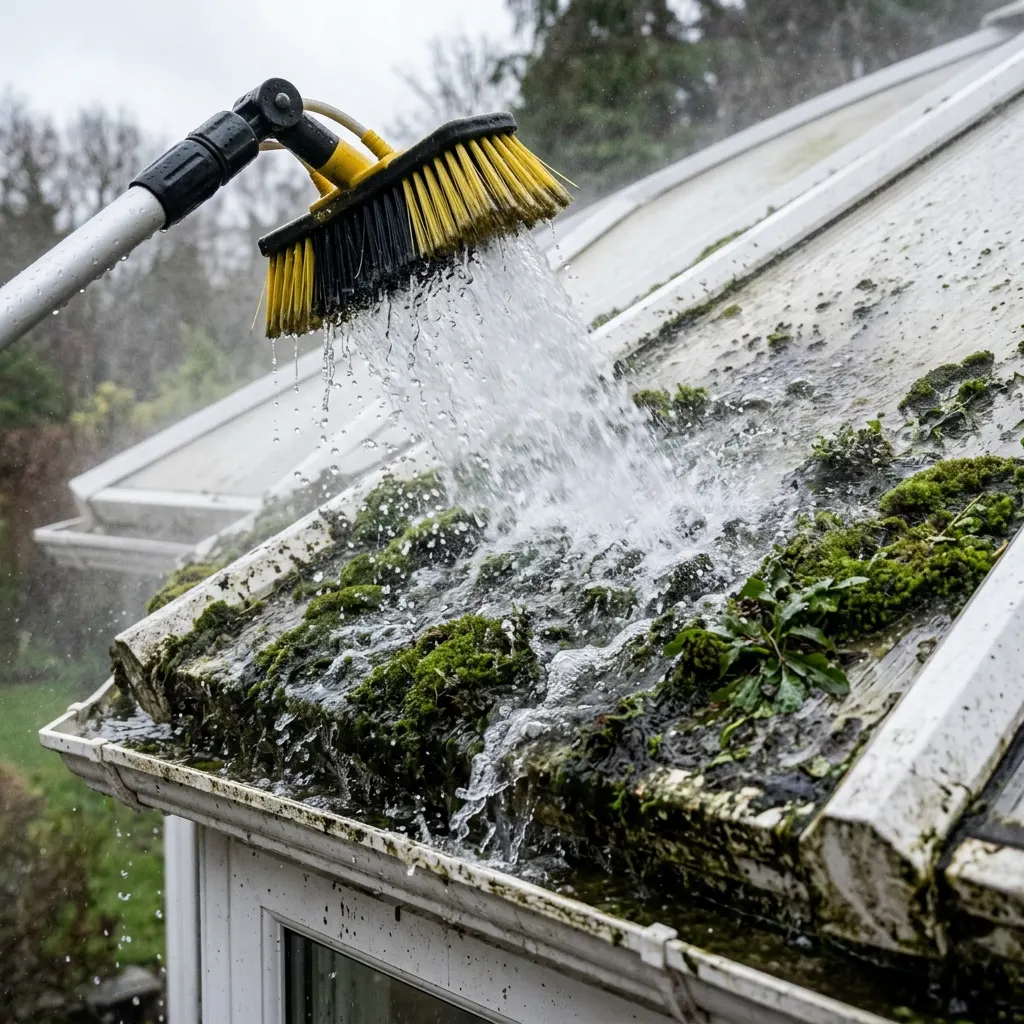
Once the structure is saturated and the dirt has softened, we work from the ridge downward with lightweight, rigid carbon fibre poles - finials first, then the glazing bars, then the wider UPVC framework.
The gentle heat in the water behaves like a natural solvent, and paired with soft, flocked brush heads it draws dirt out of the porous surface of the plastic rather than just pushing it around, taking the frames from a weathered grey back toward their original white.
Phase 3: The Degreasing Flush
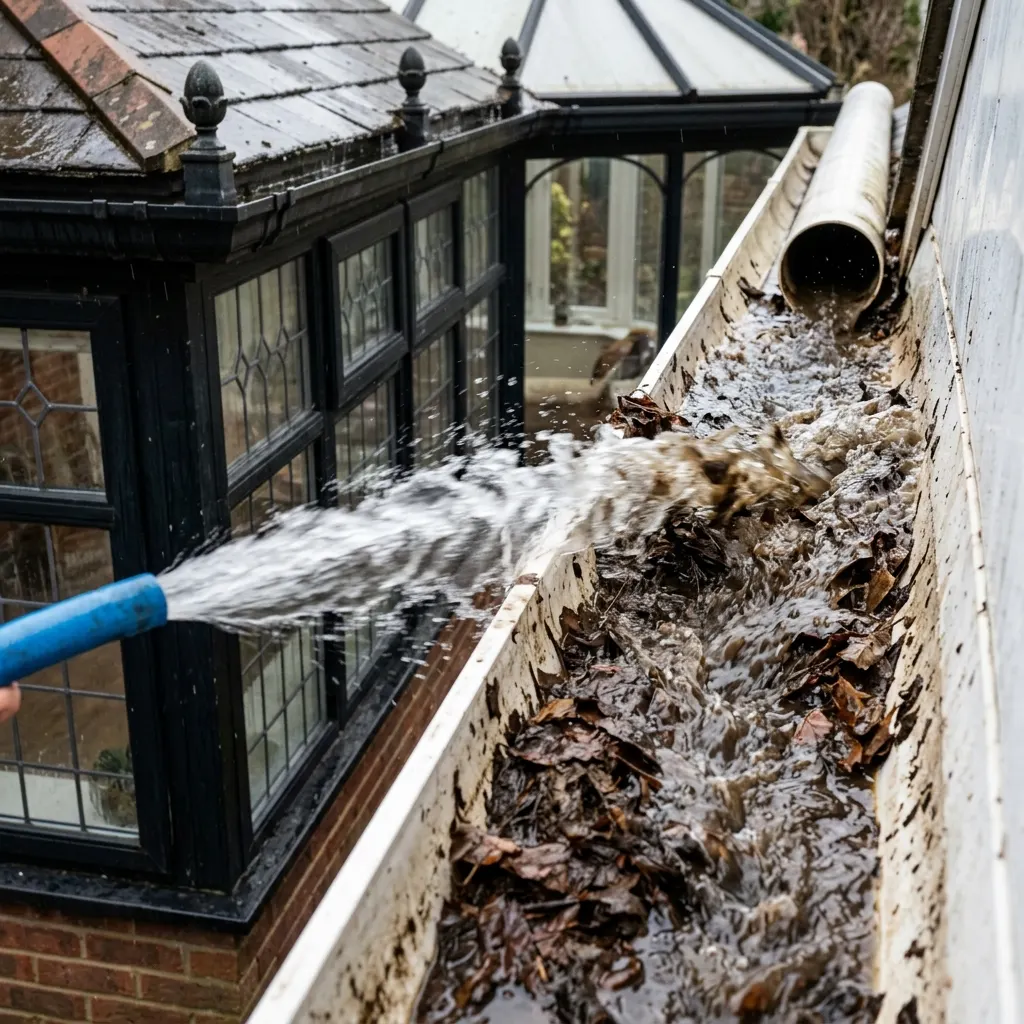
With the dirt loosened and suspended in the water, we follow immediately with a high-flow pure water rinse, carrying away silt, spores and dissolved traffic film before any of it has a chance to dry back onto the glass.
This is also where we pay close attention to the internal valleys, the hidden box gutters and the downpipes, flushing them thoroughly so the whole drainage system is genuinely clear of packed leaf mulch and moss rather than just superficially rinsed.
Phase 4: Surgical 0 TDS Rinse
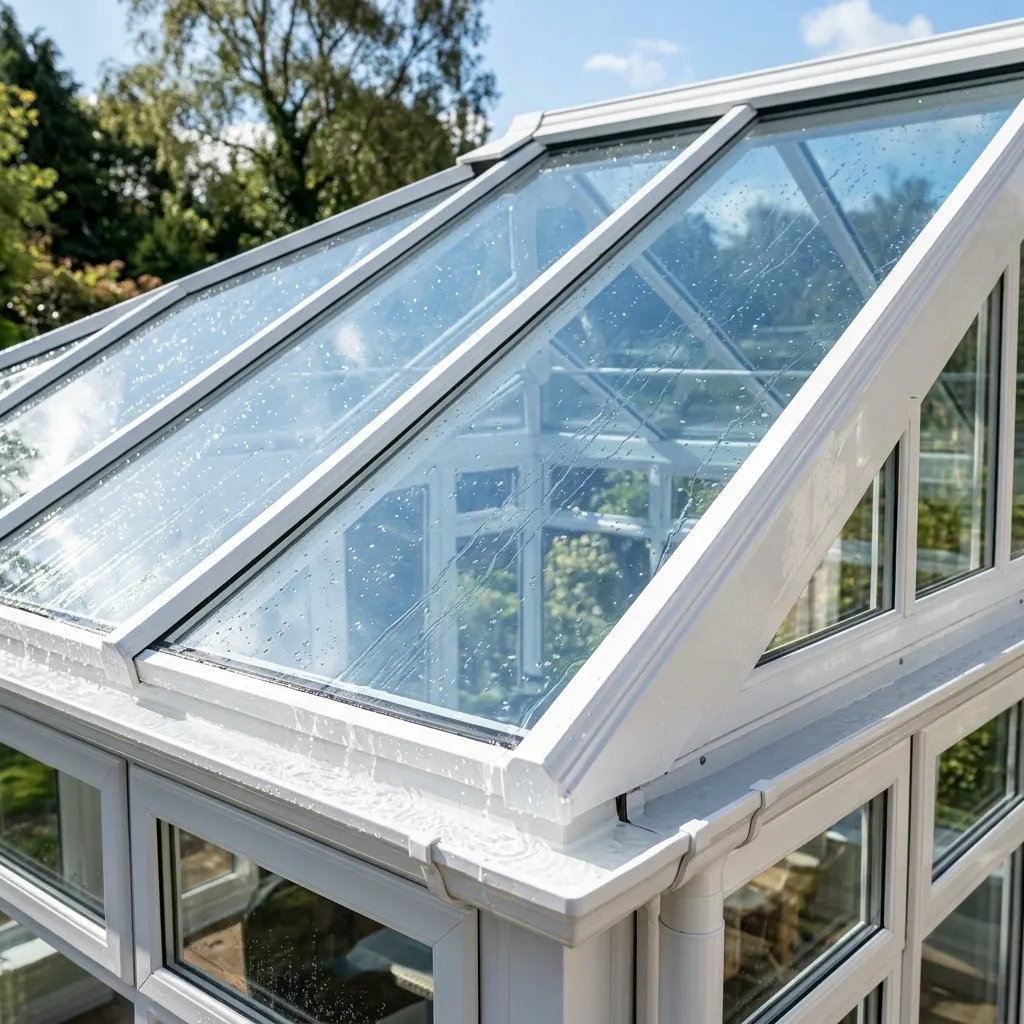
The final stage is a rinse using fully deionised water filtered close to 0 parts per million. Because it carries no dissolved minerals, we never dry the conservatory by hand with cloths or squeegees - the water simply evaporates on its own.
That leaves the glass and UPVC with a clear, streak-free finish, without the white mineral spots and smears left behind when ordinary tap water dries on hot glass.
Substrate Specific Calibration
Not every conservatory roof is built the same way. Whether yours has self-cleaning glass or traditional multiwall polycarbonate, we adjust brush stiffness, water temperature and water purity to suit.
Self-Cleaning Glass
Photocatalytic CoatingModern glass conservatories often carry a factory-applied photocatalytic coating, designed to use UV light to break down organic dirt while its hydrophilic properties encourage rain to sheet off rather than bead. Household detergents, stiff brushes or harsh industrial chemicals can strip or scratch this coating, permanently ending its self-cleaning function.
Our Conservatory Cleaning Eaglescliffe methodology uses purified, additive-free deionised water to lift dirt without touching the coating, so the glass keeps performing its self-cleaning role long after we have left the property.
Structured Polycarbonate
Multiwall ConstructionPolycarbonate roofing is lightweight and a genuinely good insulator, which is why it appears on so many local extensions. But at a microscopic level the surface is porous and easy to scratch permanently. Cheap, stiff-bristle brushes leave thousands of tiny scratches across the roof, and over time these trap dirt, algae and soot until the panel looks permanently foggy and clouded.
To avoid that, we use premium boar's-hair-style soft-flocked brushes instead, which glide across the surface, lifting the dull grey film of algae and traffic soot without abrading or damaging the multiwall panels beneath.
Frequently Asked Questions
Common questions about our premium conservatory restoration service.
More Services
We Offer in Eaglescliffe
From ground level to roofline — Operation Clean protects every inch of your property's exterior.

Window Cleaning in Eaglescliffe
Heated pure water & TFR degreasing for a long-lasting, streak-free finish on every pane.

Gutter Clearing in Eaglescliffe
3,000W industrial vacuum extraction with HD camera verification — entirely from the ground.
Soffit & Fascia Cleaning in Eaglescliffe
Bio-degradable UPVC roofline restoration returning your plastics to brilliant, factory-white.

Solar Panel Cleaning in Eaglescliffe
Restore peak energy output by removing bio-film with 000 PPM zero-TDS pure water.

Commercial Cleaning in Eaglescliffe
SafeContractor approved B2B exterior maintenance with full RAMS and £5M+ cover.
Areas We Provide This Service
Book Your Conservatory Restoration Today.
Select your conservatory style and rough size, tell us a little about its current condition, and get a transparent, accurate price instantly on screen. Secure your Conservatory Cleaning Eaglescliffe slot today.
No-Obligation Pricing
We confirm the right details before pricing.
Fast Response
We usually reply within the hour — no waiting on hold.