
Solar Panel Cleaning
in Hartlepool
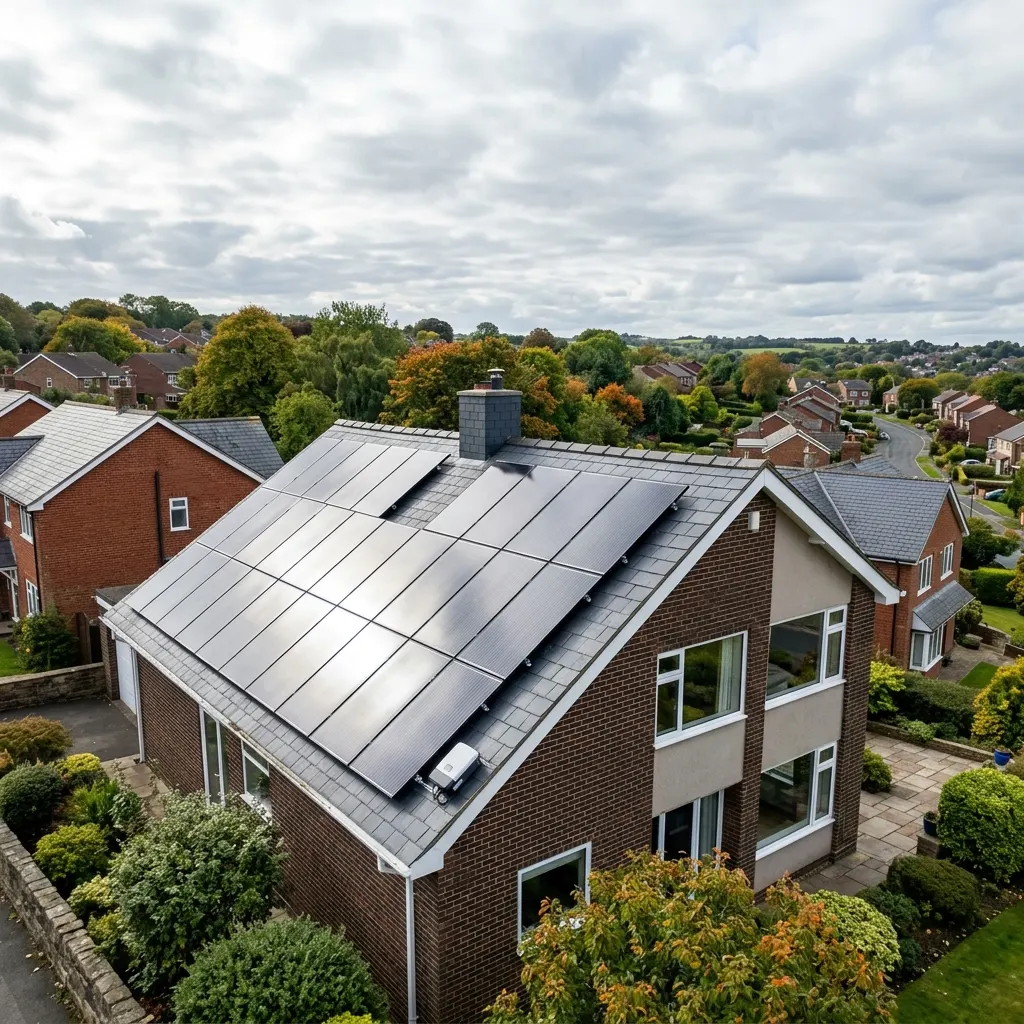
Salt off the North Sea, gull fouling, and the general grime of a working coastal town all sit quietly on your panels, cutting the generation you paid the system to produce. We provide a technical restoration service built to protect that investment and get your yield back to where it should be.

What Hartlepool customers actually say
“Brilliant service with first class communication. Friendly and professional. Highly recommended!”
“Sam has been really professional and exceptional in his service with us. Very responsive throughout the contact we have had. Sam has a very personable and friendly manner and strives to produce his best work and is more than happy to remedy any areas of concerns and is very receptive to feedback. Thank you Sam for all your support and going the extra mile.”
“Excellent service, great communication and work carried out to a very high standard. Will definitely be using again and recommended to family and friends. House looks new again, thank you.”
Why Solar Yield Drops Faster on the Hartlepool Coastline.
A postcode anywhere across the TS24 to TS26 range means your array is fighting a different fight to one twenty miles inland. Around Hartlepool Marina and along the Seaton Carew seafront, onshore wind carries fine salt spray to roof height on an almost daily basis, and it settles into the glass long before a drop in generation shows up on anyone's app. Move further back into Throston Grange, The Fens and Owton Manor and the salt doesn't disappear—it combines with ordinary street dust and diesel soot to form a residue that clings harder than either would on its own. Add a large resident gull population that nests on flat roofs and panel frames right across town, and the debris it leaves works its way not just onto the glass but down into the guttering beneath the array too. Three separate problems pulling in the same direction, and left unaddressed, they can quietly cut your energy yield by up to 25%.
"Between the salt coming off the North Sea and the gulls nesting on every flat roof from the Marina to Owton Manor, Hartlepool asks more of a solar array than most towns this size—and it shows up directly in the operating voltage."
North Sea Salt Spray & Marine Corrosion
It's the properties closest to the water—around Hartlepool Marina and the seafront at Seaton Carew—that take the worst of it. Salt carried in off the North Sea lands on tempered glass and bonds at a molecular level, building a grey, translucent haze that bounces usable sunlight straight back into the sky instead of through to the cells. That same airborne salt attacks the aluminium frames, mounting rails and steel fixing bolts holding the array to the roof, so a panel that only looks slightly dull from the garden may already be sitting on brackets that are corroding underneath, out of sight.
Agricultural Drift & Coastal Nitrates
Move inland toward Hart Village and Greatham and the airborne salt meets a different problem: fine organic dust thrown up by seasonal work on the surrounding farmland, carried back toward town on the prevailing wind. Where that dust settles into the heavy, salt-tinged dew common to this stretch of coastline, it forms a nitrate-rich film in the microscopic pores of the glass—precisely the foothold algae and lichen need to get established and start spreading.
Gull Nesting Debris & Acidic Fouling
Hartlepool's gull colonies treat almost any flat surface as prime nesting ground, and that includes panel frames on garages, bungalows and extensions from the Headland to Throston Grange. Twigs, feathers and grit get worked in between the cells and the frame, and whatever doesn't stay on the glass often washes down into the guttering below during the next downpour, adding to blockages there too. The droppings that come with a nesting season are intensely acidic, block light to the cell completely wherever they land, and slowly etch into whatever surface they sit on for long enough.
The Chemistry of 000 PPM Water.
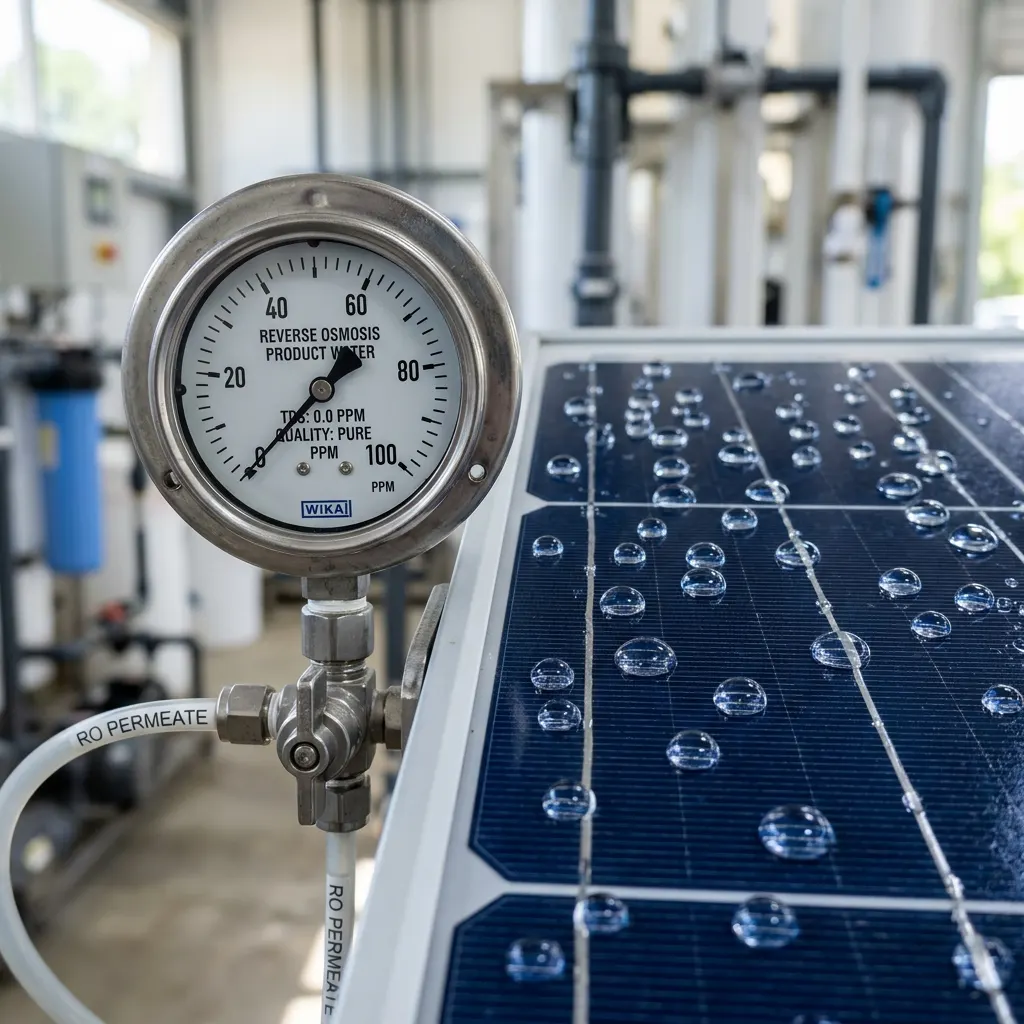
A proper solar restoration is not "a hose and a chamois". We rule out every traditional method in favour of controlled hydro-chemistry: high-flow water is run through a multi-stage Reverse Osmosis (RO) system on board the van until it reaches an absolute purity of 000 Parts Per Million (PPM)—as close to chemically pure as water gets.
Molecular Hunger
Water stripped of every mineral it naturally carries—calcium, magnesium, potassium—becomes chemically restless. It actively seeks to bind with whatever organic matter it touches, which makes it a genuinely powerful solvent against dirt, soot and the baked-on gull droppings common on Hartlepool roofs, lifting them through chemical attraction alone rather than through aggressive scrubbing or harsh detergents.
Zero-Residue Evaporation
Mains water across the Hartlepool area carries a heavy mineral load, and spraying it onto a sun-warmed panel leaves behind white calcified spots as it dries—limescale. Each of those spots acts as a tiny lens, scattering light away from the cells beneath rather than letting it through. Water filtered down to 000 PPM leaves nothing behind at all, so the finish is left surgically clean and properly transparent.
Protecting the Hydrophobic Layer
Plenty of modern panels arrive from the factory with a delicate hydrophobic or self-cleaning coating already applied. Harsh chemicals or a standard window-cleaning soap will strip that coating away within a wash or two, and once it's gone the panel attracts dirt noticeably faster than before. Pure water carries no surfactants and no detergent residue, so it cleans without ever touching that factory finish.
The Science of Yield Restoration
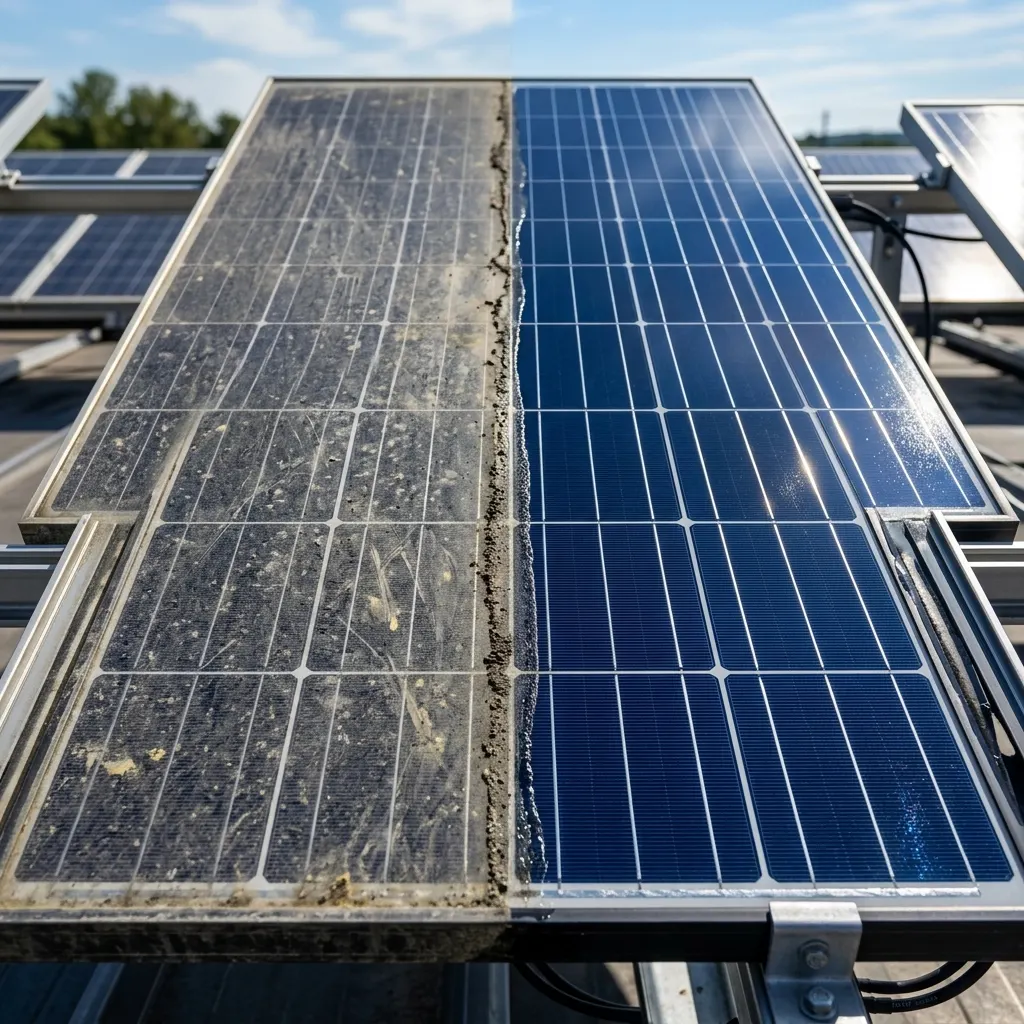
Solar panels need direct, unfiltered UV to hit the cell—that's the whole basis of how they generate power. When salt residue, gull fouling and ordinary urban grime bake onto the glass, that path is physically blocked, a process the industry calls "soiling". Plenty of homeowners in Hartlepool assume that living somewhere this exposed to rain must mean the panels get a free wash every week. In practice, it works the other way round.
Rain falling through salt-laden coastal air doesn't arrive clean—it picks up airborne particulates on the way down, and when it evaporates off a warm panel it leaves a faint, muddy film behind rather than washing anything away. Left across a typical 12 to 24-month cycle, that film thickens into a permanent, light-blocking layer. A professional clean gives the silicon cells an unobstructed view of the sky again and brings the system back up to its proper operating voltage.
Keeping the surface clear isn't just about appearances, either—it's what lets the inverter logic run along its intended efficiency curve. Even a small patch of shading in one corner, caused by nothing more than a build-up of debris or a single gull dropping, is enough to trigger a panel's bypass diodes and cut generation sharply across the whole string, not just the shaded cell.
Protecting the AR Coating
Modern panels rely on a genuinely delicate Anti-Reflective coating to capture extra light at low sun angles—useful on a coastal stretch where haze and low winter light are routine. Household detergents and general-purpose chemicals degrade that coating over repeated washes. We use no chemicals at all, relying purely on the solvency of deionised water to lift dirt without touching the coating underneath.
Our 4-Step Technical Process
A solar array is a live, high-voltage system fixed to your roof, and we treat it that way throughout. Every stage of the clean follows the same safety protocol, regardless of property type or postcode.
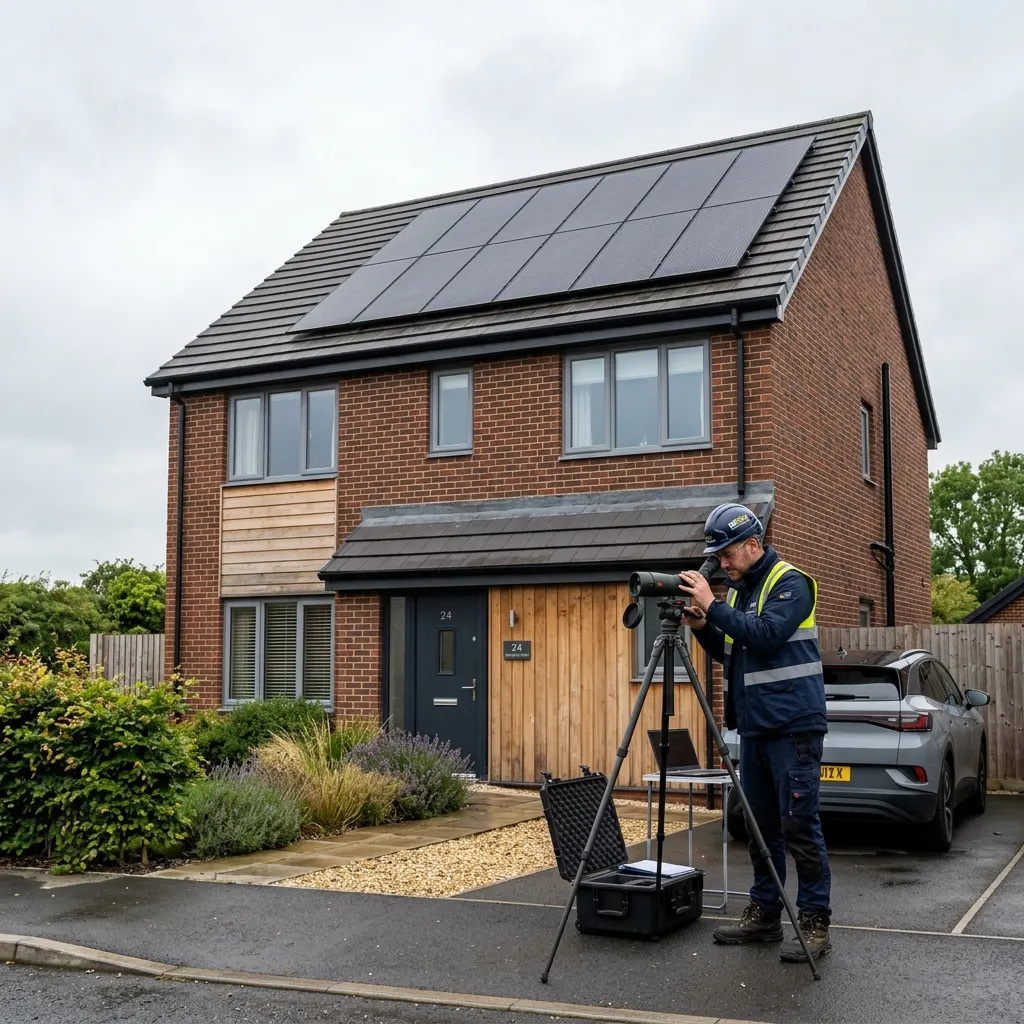
Ground-Level Thermal Assessment
Before any water goes near your roof, we survey the whole array from ground level using high-reach optics, checking for anything that shouldn't be there—hairline cracks, "snail trails" on the cell surface, or frame damage that could let water in once we start.
That record shapes which method we use and where: a terraced roof in Owton Manor is treated differently to a ground-mounted commercial system down near the Hartlepool docklands, and knowing the starting condition means nothing gets missed once we're up there.
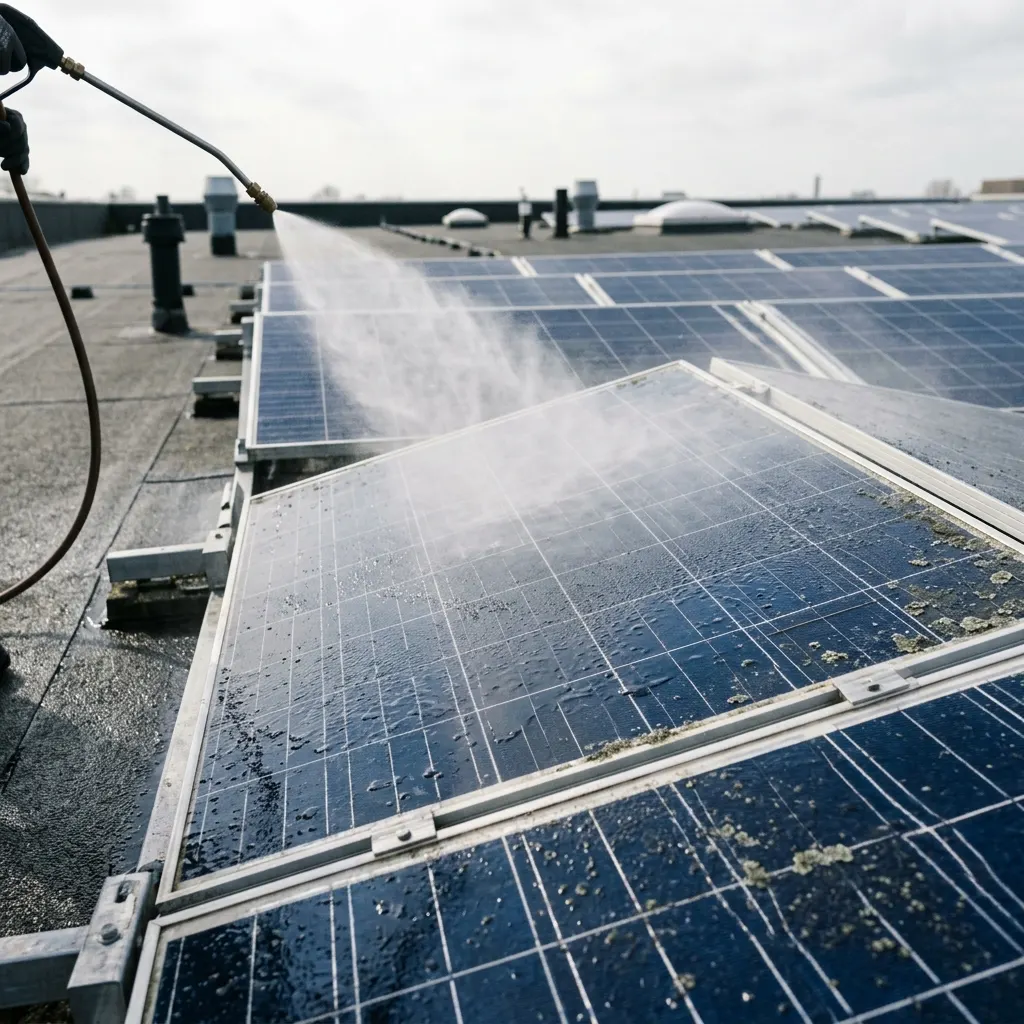
Pure Water Saturation & Pre-Soak
Lichen and coastal moss get a real foothold in the tight gaps between panels here, helped along by the damp sea air. On heavily soiled arrays we start by misting the whole surface with a low-pressure, high-volume application of pure water, giving the baked-on biological matter time to properly soften before we touch it.
That mist works nothing like passive rain—it fully rehydrates the stubborn grip of salt-crusted grime and dried gull droppings, loosening it enough to rinse away safely rather than needing to be scraped off, which is how glass gets scratched.
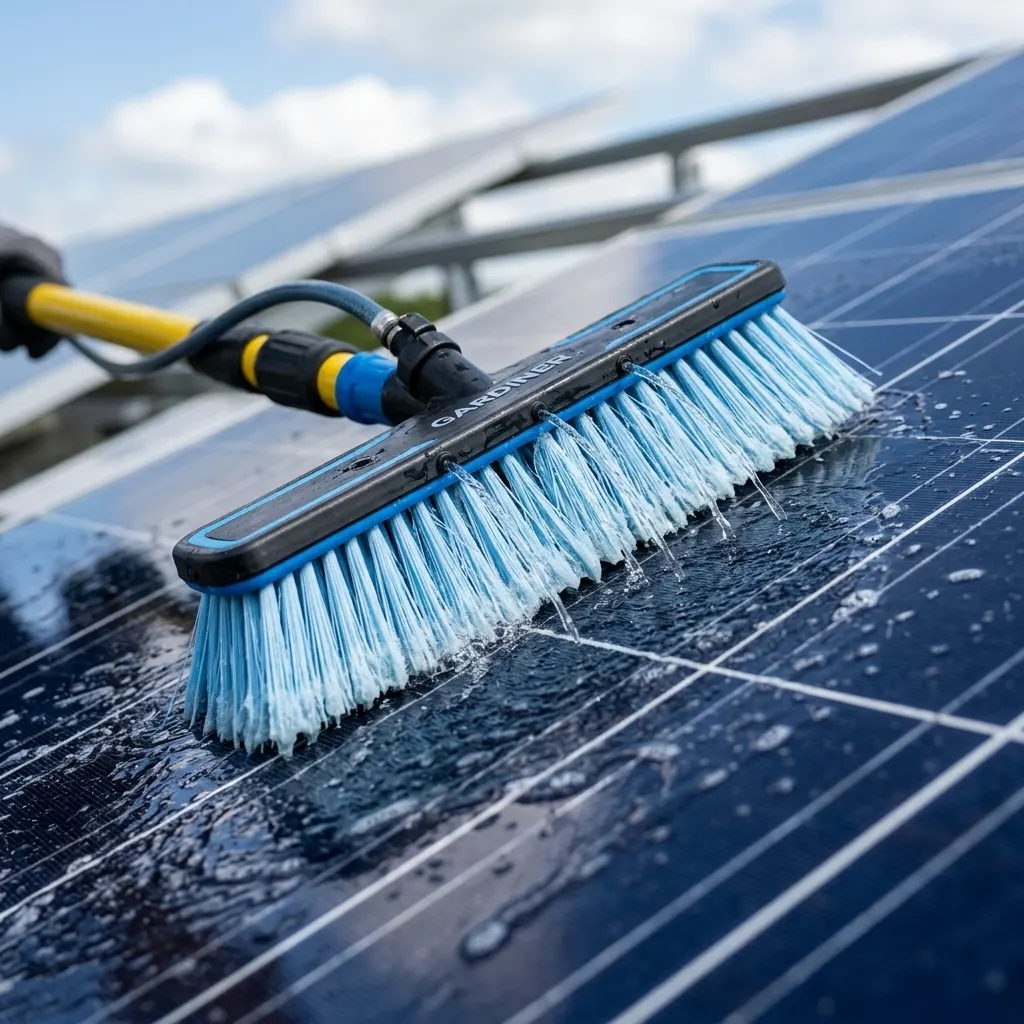
Precision Brush Agitation
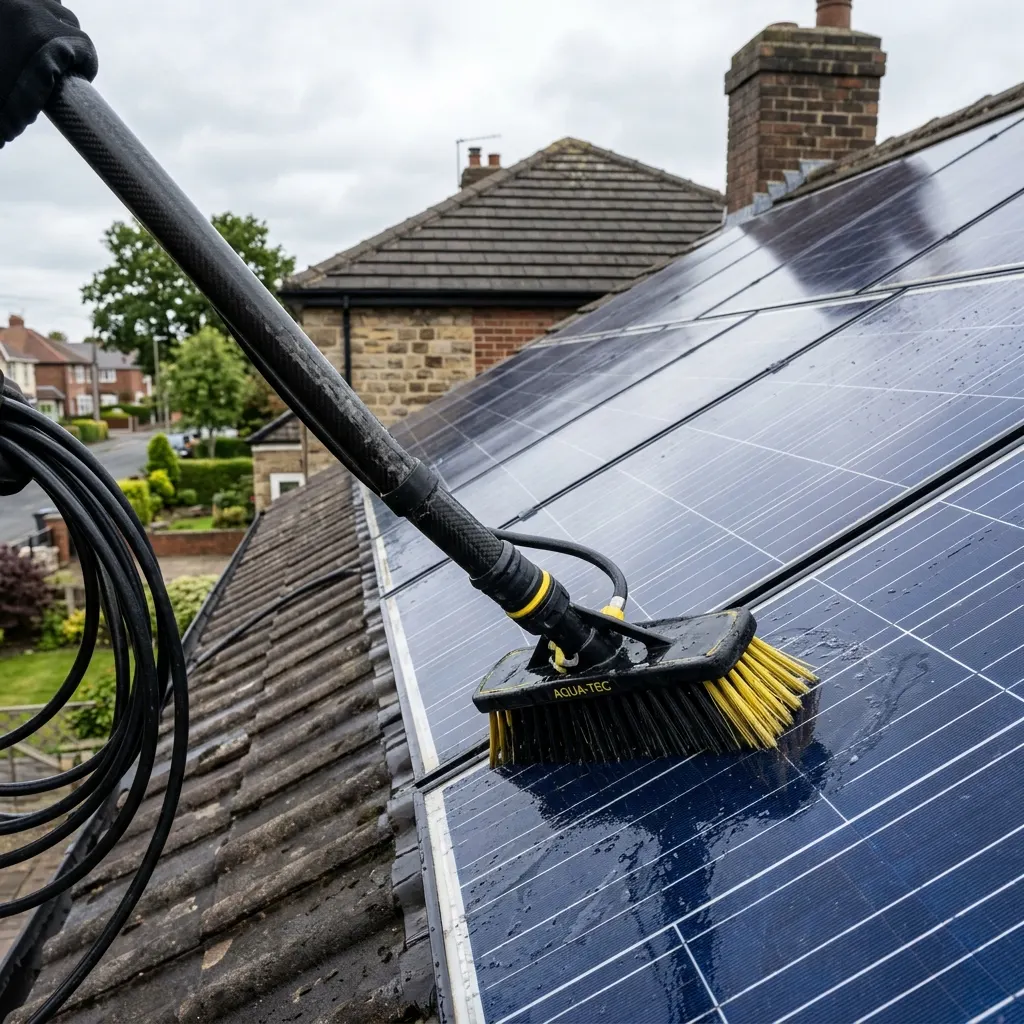
We then work each panel individually with specialist solar brushes finished in soft, flocked bristle, agitating the loosened grime rather than attacking it. No downward weight ever goes through the brush and onto the glass—the cells beneath are too fragile for that.
Particular attention goes to the lower edge of the frame, where wind-blown grit and nesting debris collect into a kind of dam. Clear that and rainwater can drain properly afterwards, which is what actually stops algae re-establishing and the hot-spot cell damage that follows it.
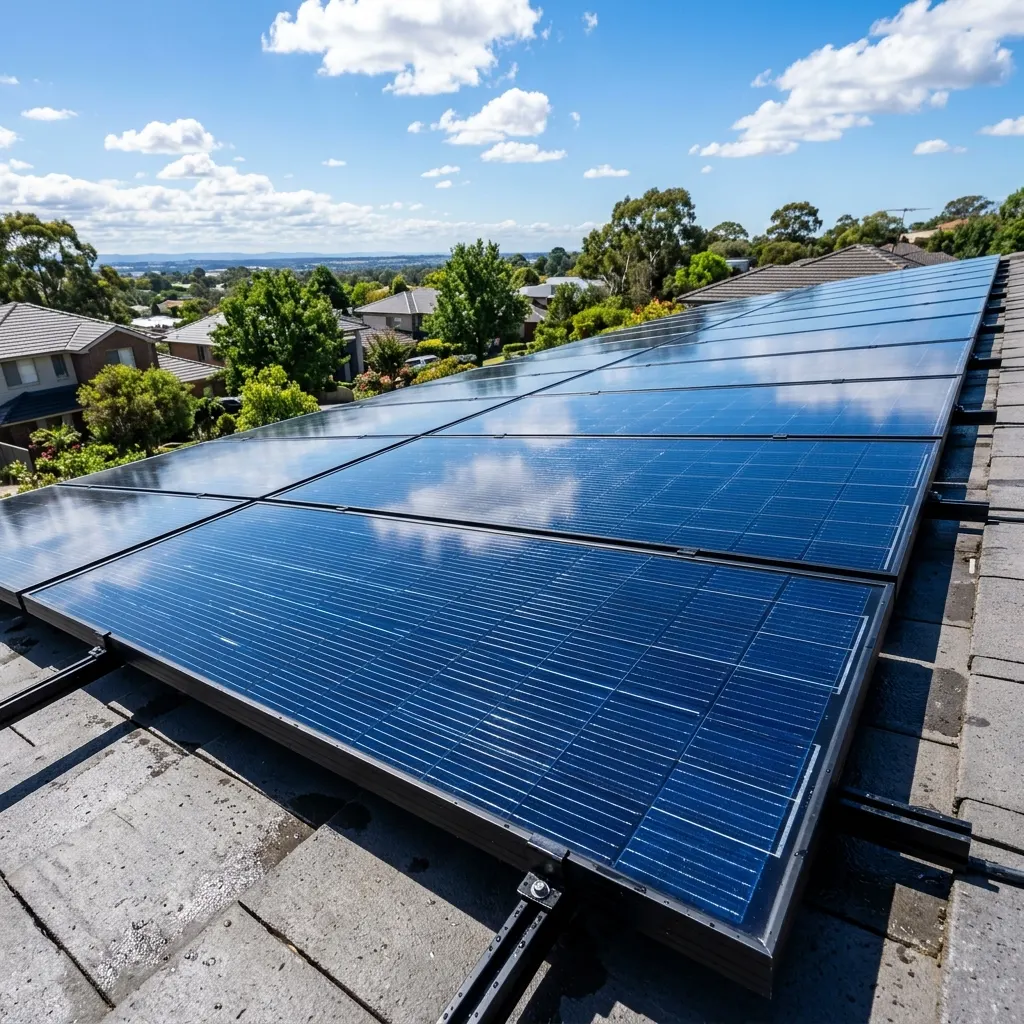
The Final Zero-Residue Rinse
We close the job with a heavy, high-flow rinse of deionised water held at exactly 000 PPM. At that purity the water behaves like a magnet for whatever microscopic particles remain, carrying them off the panel and clear of the roofline entirely.
What's left is genuinely "surgically clean"—no streaks, no smears, no mineral spotting—with the tempered glass restored to full transparency and ready to make the most of whatever Hartlepool sunlight comes its way.
The ROI of Clean Solar Panels.
Professional Solar Panel Cleaning in Hartlepool pays for itself in generation, not just appearance. Salt, soot and gull fouling throttle output gradually enough that most homeowners never notice the decline—only the recovery once it's cleaned.
In the North East, our limited daylight hours make energy efficiency paramount. A mere 5% drop in efficiency due to industrial soot might seem minor, but compounded over 365 days, it results in hundreds of lost kilowatt-hours.
"For most systems in Middlesbrough or Stockton, the generation gain from a professional clean typically offsets the service cost within 4–6 months."
The generation jump typically measured on a system that's gone 24 months without a clean, taken immediately after a 000 PPM pure water restoration.
What regular cleaning actually protects against: the slow build-up that leads to permanent hot spots and, eventually, premature cell failure.
Severe Soiling Throttling
In industrial corridors where soot accumulation is heavy, panels can reach a "Generation Plateau" where they lose a quarter of their potential output annually.
Protecting Your Warranty.
Manufacturers are strict about how their panels can be cleaned, and for good reason—the wrong method voids the warranty outright and can genuinely damage the silicon cells underneath.
Zero-Pressure Cleaning
We never use a pressure washer, full stop. High-pressure water forces its way past the rubber and silicone seals that keep an array watertight, and once that seal is compromised, the corrosion underneath is often invisible until it's serious. Our low-pressure pure water system sits well within every major manufacturer's guidelines.
Telescopic Ground-Access
Every clean is carried out from the ground using rigid, telescopic carbon-fibre poles. No one's weight goes onto your roof tiles or the panels themselves, which is where hidden structural damage usually starts on older Hartlepool roofs.
Deionised Solvent-Free
No detergents, no soaps—just deionised water. Ordinary household cleaning products leave a faint, sticky film that attracts dust straight back onto the glass within days. Pure water is the cleanest solvent available, and it leaves the anti-reflective coating exactly as the manufacturer intended.
Avoid "Panel Walking"
Some providers walk on panels to reach the centre of an array. Even if the glass doesn't crack, the weight creates "Micro-Cracks" in the internal silicon cells, resulting in immediate efficiency loss and a permanent fire hazard. Operation Clean operates 100% from the ground.
Serving Hartlepool & The North East
Every part of Hartlepool sits somewhere different on the scale between salt exposure and inland dust, and where your property falls on that scale changes how we approach the clean.
Hartlepool Marina & The Headland
Marine diesel soot from the harbour and near-constant salt spray both land here first, before anywhere else in town. Arrays around the Marina and Headland need the most frequent attention of any area we cover.
Seaton Carew & Coastal Approaches
The volume of gull activity along this stretch of seafront makes acidic droppings the dominant problem here, not just salt film. Our pure-water pre-soak is built specifically to dissolve that fouling without abrasive scrubbing.
West Park, Bishop Cuthbert & Suburbs
Further from the water, the challenge shifts to ordinary residential grime—traffic film, domestic soot and winter run-off—rather than salt. Regular cleaning here is mainly about protecting the summer generation window, when the financial upside is greatest.
Elwick, Dalton Piercy & Rural Outskirts
Out toward the rural edge of town, agricultural dust and organic growth are the bigger factors. Lichen and moss get real purchase in these conditions, so we lean on the low-pressure bio-soak stage longer here than we would on a coastal property.
Window Cleaning FAQs
Common questions about the pure water process, expertly answered.
How much does Solar Panel Cleaning in Hartlepool cost?
Do I need to turn my solar system off during the clean?
How often should I have my panels professionally cleaned in Hartlepool?
Will you walk on my roof or lean on the panels?
The ROI: Does the clean really pay for itself?
What is 000 PPM water, and why does it matter so much?
Can’t I just wait for the North East rain to clean them naturally?
More Services
We Offer in Hartlepool
From ground level to roofline — Operation Clean protects every inch of your property's exterior.

Window Cleaning in Hartlepool
Heated pure water & TFR degreasing for a long-lasting, streak-free finish on every pane.

Gutter Clearing in Hartlepool
3,000W industrial vacuum extraction with HD camera verification — entirely from the ground.

Soffit & Fascia Cleaning in Hartlepool
Bio-degradable UPVC roofline restoration returning your plastics to brilliant, factory-white.

Conservatory Cleaning in Hartlepool
Full structural valet for glass and polycarbonate roofs — inside, outside, and every valley.

Commercial Cleaning in Hartlepool
SafeContractor approved B2B exterior maintenance with full RAMS and £5M+ cover.
Roof Soft Washing in Hartlepool
HSE-approved dry-scrape and 12v low-pressure biocide treatment — moss removal without damaging your tiles.

Solar Panel Bird Proofing in Hartlepool
Non-drill mesh permanently seals the gap under your array from nesting birds.
Areas We Provide This Service
Book Your Solar Scrub.
Select the exact number of panels you have and see a completely transparent price on screen immediately. No salesmen. No pressure.
No-Obligation Pricing
We confirm the right details before pricing.
Fast Response
We usually reply within the hour — no waiting on hold.